In Silico vs. In Vitro vs. In Vivo: When to Use Each Method in Medical Device Development
To demonstrate the safety and efficacy of medical devices, there are three testing approaches: in vitro on the bench, in vivo in living systems, and in silico on the computer. Each has its strengths, its limitations, and a clearly defined role in the development process. Modern medical device development uses all three methods in combination, not as alternatives to one another.
At Virtonomy, we help MedTech companies use in silico simulations as part of a regulatory-grounded development strategy. The following overview shows how in vitro, in vivo, and in silico methods can be meaningfully combined.
Key Takeaways
- In vitro refers to bench testing under laboratory conditions, in vivo to testing in living systems (animal or human), and in silico to computational simulation on virtual patient cohorts.
- Each method has a clearly defined role: in vitro for mechanical and material-related performance, in vivo for biological response and clinical safety, and in silico for population coverage and worst-case scenarios.
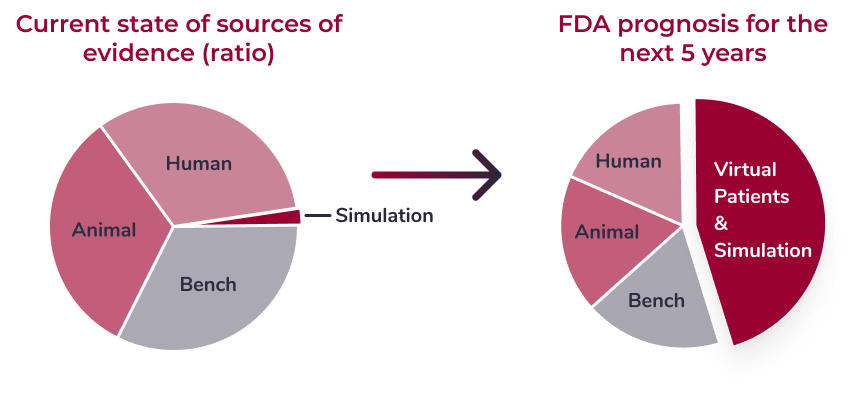
- Modern cardiovascular medical device development combines all three methods in a hybrid approach. In silico methods are now accepted by the FDA and EU Notified Bodies as part of the regulatory evidence.
The Three Pillars of Medical Device Evidence
In vitro, in vivo, and in silico testing form the three evidence pillars of modern medical device development. Depending on the device class, intended purpose, and risk profile, in vitro, in vivo, and in silico evidence can be combined with different degrees of emphasis.
The terms in vitro and in vivo come from Latin. In silico is a modern coinage modeled on these Latin terms: in vitro means “in glass,” in vivo “in the living,” and in silico “in silicon.” Together they describe the location of the investigation, not the actual object under investigation. In a typical development process for cardiovascular medical devices, in silico models first analyze the design space and the anatomical variability of virtual patients. In vitro test rigs then validate the mechanical and material-related properties of the most promising designs. Finally, in vivo studies confirm biological safety and clinical efficacy before and after approval.
What Is In Vitro Testing?
In vitro testing is the physical testing of a medical device under controlled laboratory conditions, outside any living system. It uses test rigs, mock circulatory systems, fatigue test benches, and material characterization equipment to measure mechanical and material-related performance.
When in vitro testing is used
- Early design validation, to confirm that the device functions mechanically as intended
- Material characterization as well as durability and fatigue testing
- Biological evaluation and biocompatibility testing using suitable in vitro methods
- Conformity testing against standards, such as ISO 5840, the international series of standards for heart valve replacement systems and their testing
- Quality control during manufacturing
- Depending on the device, intended purpose, and applicable standards, an essential part of the technical performance evidence
Strengths and Limitations
In vitro testing is reproducible, controlled, backed by established standards, and associated with comparatively low costs per test. However, it cannot capture anatomical variability or physiological response, and mock environments simplify a reality that in vivo and in silico methods represent more comprehensively. Patient-specific factors, such as calcification patterns or vessel geometry, lie conceptually outside its scope.
What Is In Vivo Testing?
In vivo testing is the testing of a medical device in a living organism, in both animal studies and human clinical trials. It provides evidence on biological response, clinical safety, and real-world performance that physical and computational methods alone cannot deliver.
When in vivo testing is used
- Pre-clinical animal studies before the first use in humans
- Early Feasibility Studies (EFS) for the first evaluation of novel devices in humans
- Pivotal studies to demonstrate safety and efficacy for approval
- Post-market clinical follow-up (PMCF) and long-term surveillance
- Required for higher risk classes (FDA Class III, EU MDR Class III, and most Class IIb) as well as for most novel cardiovascular devices
Strengths and Limitations
In vivo testing provides insights into biological response and clinical performance under real-world conditions that bench tests and simulations alone cannot fully capture. Against this stand considerable drawbacks: pivotal cardiovascular studies are among the most expensive studies in the MedTech field, timelines span months to years, and recruitment is difficult—especially for pediatric patients, female patients, and rare anatomies. The use of animals brings an ethical and regulatory burden, and results from animal models cannot always be transferred one-to-one to human physiology.
What Is In Silico Testing?
In silico testing is the computational simulation of a medical device on virtual patient models. Depending on the device class, blood flow, mechanical stresses, implantation paths, or material loads, for example, are simulated to validate design decisions before physical testing.
When supported by suitable evidence of model credibility per ASME V&V 40 (Verification and Validation 40, the standard for establishing the credibility of computational models for medical devices), in silico evidence can be considered as part of regulatory submissions by the FDA under its guidance on assessing computational models and—within the framework of Annex XIV of the EU Medical Device Regulation (MDR) on clinical evaluation—by EU Notified Bodies as well.
As a provider of browser-based in silico simulations for cardiovascular medical devices, Virtonomy continuously tracks regulatory developments around ASME V&V 40, the FDA, and the EU MDR.
Want to dive deeper into the topic?
Learn how in silico clinical trials work, what role ASME V&V 40 plays, and how the FDA and EU assess virtual evidence.
When in silico testing is used
- Early design exploration without physical prototypes
- Virtual implantation and fit testing across hundreds of patient anatomies; implantation paths, device sizes, and anatomical parameters such as vessel curvatures, bending radii, or calcifications can be systematically analyzed.
- Identification of worst-case scenarios before physical testing
- Population analyses to define target populations, derive inclusion and exclusion criteria, and investigate anatomical edge cases across diverse cohorts.
- Regulatory evidence following the ASME V&V 40 credibility framework
- Hemodynamic performance analyses for heart valve devices, including blood flow, regurgitation, and the risks of hemolysis or thrombus formation.
- Fatigue analyses for implants, accounting for crimping, deployment, and cyclic loading.
Strengths and Limitations
In silico testing runs fast, with iterations in the range of days rather than months, and incurs low marginal costs once the model is validated. It covers entire patient populations without ethical burden and delivers reproducible results. The limitation lies upstream: it requires validated models and a corresponding validation effort beforehand, and its reliability depends on the quality of the input data. It does not fully replace clinical evidence for safety endpoints.
Direct Comparison
| Criterion | In Vitro | In Vivo | In Silico |
|---|---|---|---|
| What is tested | Mechanical and material-related performance | Biological response, clinical safety | Device behavior across virtual patient cohorts |
| Environment | Lab bench, mock setups | Living animal or human | Computer simulation |
| Time per iteration | Days to weeks | Months to years | Hours to days |
| Cost per iteration | Low to medium | High to very high | Low to medium |
| Population diversity | None (single test setup) | Limited by recruitment | High (curated cohorts) |
| Regulatory acceptance | Established, required | Established, required for most devices | Established under ASME V&V 40 |
| Ethical considerations | Minimal | High (animals, humans) | Minimal |
| Typical phase | Throughout development | Pre-clinical and clinical | Early design to approval |
When to Use Each Method
The three methods complement rather than compete with one another. The choice depends on the development phase, the question to be answered, and the regulatory requirements of the respective device class.
Early Design and Concept
In silico offers the fastest iteration in this phase, since no prototypes are needed and a broad design space can be explored in software. In vitro follows once a candidate design is available, with targeted bench tests to confirm mechanical feasibility. In vivo is not yet appropriate at this stage.
Pre-Clinical Development
In vitro testing provides conformity with ISO standards as well as fatigue and durability data. In silico simulation extends population coverage, identifies worst-case scenarios, and represents anatomical variability across virtual cohorts. In vivo animal studies provide the first evidence of biological response and acute safety.
Regulatory Approval
In vitro data form a required component of the bench-test evidence in every submission. In silico evidence is increasingly accepted for population coverage and edge cases under the ASME V&V 40 credibility framework. In vivo data from clinical trials provide the safety and efficacy endpoints required by regulatory authorities.
Post-Market and Iteration
In silico models enable the rapid evaluation of edge cases reported in the field. In vitro testing supports the targeted re-testing of modified designs. In vivo post-market surveillance and long-term follow-up close the loop back to real-world performance.
Would you like to know how in silico simulation can be integrated into your existing development process?
Together, we’ll show you where v-Patients meaningfully complements in vitro and in vivo testing.
The Modern Hybrid Approach
Cardiovascular medical device development today does not mean choosing a single method. In silico simulation screens hundreds of design variants and patient cases for which in vivo studies could never recruit enough participants, giving engineers early insight into failure modes and population-wide risks. In vitro testing then validates the designs that survive the in silico screening, confirming mechanical and material-related performance under controlled conditions. In vivo studies confirm the safety and efficacy of the most promising final designs and provide the clinical evidence that regulatory authorities require before and after approval.
This hybrid approach also ties in with the 3Rs principle (Replace, Reduce, Refine), the internationally recognized guiding framework for ethical animal research. In silico methods support the Reduce principle by lowering the number of animal studies needed to explore design variants and edge cases, without eliminating the need for clinical evidence where it remains indispensable.
This combination of in silico, in vitro, and in vivo evidence forms the basis of many projects that Virtonomy supports together with MedTech companies in the cardiovascular field.
Where Virtonomy Comes In
With v-Patients, Virtonomy is developing a platform for in silico simulations of cardiovascular medical devices. The platform offers more than 2,500 digital patient twins, a browser-based simulation environment, and results structured for FDA and EU submissions. Cardiovascular MedTech companies use it to complement their existing in vitro and in vivo workflows, not as a replacement for either method.
Two examples show how this hybrid approach works in practice:
Fatigue Evidence for a First-in-Human Implantation
For a compassionate-use application to the German Federal Institute for Drugs and Medical Devices (BfArM), fatigue data were missing to assess the durability of a cardiovascular medical device. The available submission window was only three weeks. Within that time frame, Virtonomy delivered simulation-based fatigue evidence—instead of the roughly six months estimated for conventional evidence.
The simulation was based on in vivo loading conditions; the regulatory report was prepared in line with the FDA Reporting Guidance. The results supported the durability evidence in the compassionate-use application and contributed to the successful first-in-human implantation of the device in Germany.
Reduced Trial Size and Earlier Market Launch
In a use case documented by the Drug Information Association, engineering simulations supported the development of a pacemaker. This made it possible to reduce the number of required trial participants by 256. The device was launched two years earlier; the cost reduction associated with the smaller trial size was reported at 10 million US dollars.
Both examples show how in silico methods complement the hybrid development approach: they replace neither in vitro nor in vivo testing, but they can shorten development cycles, support regulatory evidence, and shape the scope of physical studies more precisely.
Get to know Virtonomy’s v-Patients platform.
Learn how virtual patient cohorts, browser-based simulations, and regulatory-structured results are used in real-world development projects.
Frequently Asked Questions
What is the difference between in silico, in vitro, and in vivo testing?
In vitro testing takes place on the bench under controlled laboratory conditions, without a living system. In vivo testing takes place in a living organism, animal or human. In silico testing takes place entirely in software and simulates device behavior on virtual patient models. Each method provides a different type of evidence, and regulatory authorities typically expect a combination of all three.
Can in silico testing replace animal testing?
Not entirely. In silico methods reduce the number of animal studies needed by computationally screening design variants and edge cases before physical testing, in the spirit of the Reduce principle of the 3Rs. Clinical and biological safety endpoints still require in vivo evidence, so in silico acts as a complement to animal and human studies rather than replacing them.
Does the FDA accept in silico evidence in device submissions?
Yes. The FDA can consider in silico evidence when it is developed and documented under a recognized credibility framework such as ASME V&V 40; the corresponding guidance was finalized in November 2023. EU Notified Bodies impose comparable requirements under Annex XIV of the EU MDR. In silico evidence typically supports population coverage, worst-case analyses, and design exploration, rather than serving alone as proof of safety and efficacy.
Which method is most cost-effective for the early development phase?
In silico testing is generally the most cost-effective option for the early development phase. It requires no physical prototypes, runs in iterations of hours to days rather than months, and—once the underlying models are validated—covers a broad range of virtual patient anatomies at low marginal cost.
In Brief
In vitro, in vivo, and in silico testing are not competing approaches but three building blocks of a shared evidence strategy. Each method answers different questions and contributes to demonstrating the safety, performance, and regulatory conformity of a medical device. Which method is used depends on the respective development phase, the specific question at hand, and the regulatory requirements.
In silico methods are becoming increasingly important in this context. They enable rapid design iterations, the investigation of large virtual patient cohorts, and the early identification of potential risks. Combined with in vitro and in vivo testing, they create a hybrid development approach that makes development processes more efficient while meeting the requirements of the FDA, the EU MDR, and international standards.
Ready to incorporate in silico simulation into your development strategy?
Talk with Virtonomy’s experts about your use case and learn how virtual trials can be meaningfully combined with existing in vitro and in vivo workflows.