The anatomy of the tricuspid valve can be more challenging that that of the aortic and mitral valve. Because of its variability, central design decisions in transcatheter tricuspid valve replacement (TTVR) can be more complicated. Sizing and positioning become even more complex because the annulus changes shape over the cardiac cycle. At the same time, the device must withstand long-term dynamic loading. Physical studies in this patient group are also constrained by recruitment, cost, and ethical limits.
TTVR simulation on digital patient twins gives development teams a way to address these constraints in a targeted manner. It makes it possible to validate anatomical fit, iterate designs, and generate regulatory-relevant evidence faster than would be possible with physical prototyping and cadaver studies alone. This article walks through the development of a transcatheter tricuspid valve replacement on the v-Patients platform—from cohort selection through virtual implantation to validation.
The Challenges of Transcatheter Tricuspid Valve Replacement
Transcatheter tricuspid valve replacement can be harder to standardize than aortic or mitral valve replacement, because several factors interact simultaneously and reduce the margin for error in sizing and positioning.
The tricuspid annulus is more variable between patients than the aortic or mitral annulus. In addition, its shape changes over the cardiac cycle rather than maintaining a fixed geometry. This variability makes the sizing and positioning of a percutaneous device particularly demanding.
Patient selection is complex as well. The target population and the inclusion and exclusion criteria are guided, among other things, by the severity of tricuspid regurgitation (TR). For development, it must therefore be clarified early which anatomical and clinical range a device is meant to cover.
After the initial sizing and positioning, long-term mechanical loading comes into play. A TTVR device must withstand recurring cardiac cycles over years, which is why durability testing is just as relevant as the initial anatomical fit.
Traditional prototype-test-refine cycles can slow this development down. Physical iterations may require new tooling and further rounds of testing. When anatomical questions are already resolved virtually, physical prototypes and cadaver studies can be reduced or planned more deliberately for early fit and anatomy analyses.
| Challenges in treating TR | How can we address them? |
|---|---|
| Ensuring Device Effectiveness: Correct size, design, positioning, and material selection of the device are crucial for effectiveness | Perform virtual implantation of various device versions on a large number of virtual TR patients |
| Complex and unique shape of Annulus Structure: The unique anatomy of the tricuspid valve, which changes shape significantly throughout the cardiac cycle, presents challenges for repairing and anchoring replacement devices. | Design and optimize innovative repair and anchoring mechanisms tailored to the target patient cohort |
| Patient Selection Criteria: Patient selection based on the severity of TR is a pivotal factor in device testing and justifying intervention | Investigate specific anatomical measurements for a statistical population analysis to explore worst-case scenarios, establish inclusion/exclusion criteria, and validate patient selection protocols |
| Dynamic Loading: Devices experience dynamic periodic loading, increasing the risk of material failure. | Conduct fatigue analysis using simulations taking into account many parameter combinations |
| High Resolution Costs: Traditional test methods, including tensile tests, fatigue evaluation, and flow assessments, are performed after prototyping, leading to high resolution costs for identified issues | Easily set up and execute simulations to evaluate the safety and performance of your device prior to creating physical prototypes. Perform simulations of anatomical conditions, including blood-organ interactions, ensuring compliance with ISO standard test cases. |
How Digital Patient Twins Support TTVR Development
v-Patients supports the development of transcatheter tricuspid valve replacement with a cohort of more than 130 patient models for tricuspid regurgitation, predominantly with severe and torrential regurgitation as well as a distribution across further severity grades. Each model is a digital patient twin reconstructed from real CT scans. The models include the geometry of the right atrium, right ventricle, pulmonary valve, and tricuspid annulus.

The cohort covers different anatomies by TR severity, sex, age, and anatomical variation. A development team can thus investigate sizing and positioning decisions across a broader range of patient anatomies, rather than limiting itself to a single representative case.
For each patient twin, v-Patients provides statistical measurements. These include the tricuspid annulus plane (TAP), cross-sectional diameters of the annulus, and parameters that change over the cardiac cycle. This data provides a quantitative basis for sizing and positioning decisions.

Teams working with their own patient data—for example, with CT scans from a clinical partner—can upload their own DICOM data. DICOM (Digital Imaging and Communications in Medicine) is the standard for storing and exchanging medical imaging data. Virtonomy’s Data & AI team anonymizes and segments this data into digital patient twins, which are then available in the same workflow for cohort selection and analysis as the reference database.
In TTVR in particular, anatomical fit can determine whether a design works across a sufficiently broad patient population. Dr. Maximilian Kütting, Director R&D at New Valve Technology (NVT), describes how central this interplay of patient anatomy, device-patient interaction, and therapy context is for development:
“Understanding patient anatomies and optimizing anatomical fit directly impacts the fate of development projects. Virtonomy’s combined expertise in specific pathologies, device/patient interactions and state of the art therapy options is tremendously valuable for anyone looking to create or optimize cardiovascular technologies.”


Understanding patient anatomies and optimizing anatomical fit directly impacts the fate of development projects. Virtonomy’s combined expertise in specific pathologies, device/patient interactions and state of the art therapy options is tremendously valuable for anyone looking to create or optimize cardiovascular technologies.

Dr. Maximilian Kütting
Director R&D New Valve Technology
How to Develop a Transcatheter Tricuspid Valve Replacement on v-Patients
Developing a transcatheter tricuspid valve replacement on v-Patients follows four steps: define the patient cohort, analyze the anatomy for sizing, perform virtual implantation and fit analysis, and investigate flow and durability.

Step 1: Define the Patient Cohort
Start by accessing the database of more than 130 right-heart models and filter by age, TR severity, and anatomical variation to represent your target population.
Alongside typical anatomies, also account for edge cases and outliers. A sizing strategy that considers only average anatomies does not adequately capture the margins of the target population.
Align the selection with the demographic and clinical parameters that actually define your target group—such as the TR severity range, an age group, or a specific anatomical subtype. This produces a cohort that matches as closely as possible the patient population the device is being developed for.
Step 2: Analyze the Anatomy and Identify the Suitable Device Size
With the defined cohort, access the available statistical measurements, including annulus diameters and parameters that change over the cardiac cycle. Compare these dimensions to derive suitable device sizes and size increments.
The cohort analysis shows what proportion of the target population a given device size can cover anatomically and where additional sizes might become necessary.
On this basis, changes to the device design can be modeled—such as to frame geometry or size increments—to address identified coverage gaps. The result is a data-driven sizing strategy before physical iterations begin.
Step 3: Perform Virtual Implantation and Fit Analysis
Implant the device virtually in the digital patient twins of your selected cohort and compare the resulting position across different anatomies.
Account for both average anatomies with an expectedly uncomplicated fit and anatomical extreme cases. It is precisely at the margins of the distribution that fit or positioning issues can become visible—ones that testing on the average patient would not reveal.
For each virtual implantation, check the overlap between the device and the surrounding anatomy to identify potential interferences. Based on these results, the device design can be iterated in silico before further physical prototypes are built.
Step 4: Run Flow and Durability Simulations
After the anatomical fit analysis, run hemodynamic simulations to investigate how the valve behaves under physiological flow conditions.
Flow analysis can help investigate risks such as regurgitation, hemolysis, or thrombosis early on. In addition, long-term durability can be evaluated by simulating recurring dynamic loading.
These simulations are guided by the testing standards of DIN EN ISO 5840 and can thereby support regulatory-relevant evidence. They complement physical testing with computational evidence and make it possible to investigate questions systematically before later testing phases.

And what about the blood?
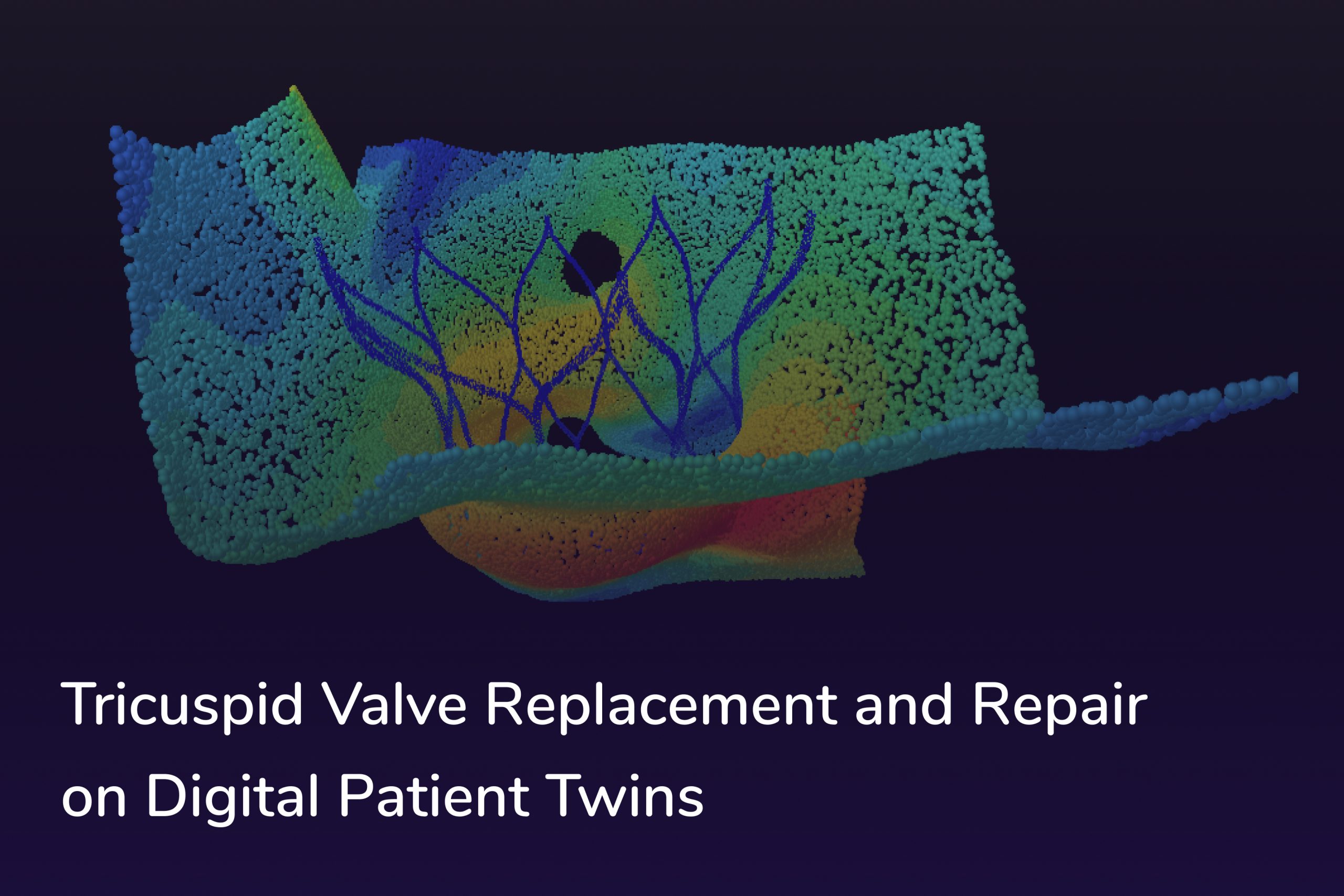
Simulation results can be used to evaluate whether the device is functioning properly and analyze blood flow behavior after the tricuspid valve replacement surgery. You can examine the flow field characteristics to predict the risk of regurgitation, hemolysis, or thrombosis. With our simulation approach, it is possible to perform Flow Assessment compliant to DIN EN ISO 5840-1.
Regulatory Benefit and Alignment with ISO 5840
TTVR simulation on v-Patients can help address requirements of DIN EN ISO 5840-1 for heart valve substitutes through in silico flow assessments and complement physical testing with computational evidence.
What is decisive for regulatory use is clear documentation of the specific question a model is meant to answer and what its results are used for. For this, a Context of Use and a Question of Interest are defined.
The FDA has published specific guidance on assessing computational modeling and simulation in medical device submissions. Under the EU MDR as well, computational evidence can be part of the technical and clinical evidence. Its regulatory weight, however, depends on the respective intended use, the credibility of the model, and the specific assessment.
An important reference framework is ASME V&V 40, a framework for assessing the credibility of computational models for medical devices. For the detailed regulatory context on Context of Use, Question of Interest, and V&V 40, see the Virtonomy guide to in silico clinical trials.
Benefits of TTVR Simulation on v-Patients
TTVR simulation on v-Patients supports development teams across several phases of the product development cycle.
- Faster iteration: Central design questions can be investigated virtually before further physical prototypes are built. This can shorten design iteration cycles from months to weeks.
- Lower iteration costs: The effort for early physical prototypes and cadaver studies for anatomy validation can decrease. Inclusion and exclusion criteria can also be investigated using virtual cohorts.
- Coverage of diverse patient populations: A device’s fit can be investigated on anatomies that are difficult or slow to recruit physically, including different TR severity grades and anatomical variations.
- Data and simulation in a single platform: Cohort selection, anatomy analysis, virtual implantation, and flow simulation can be mapped in a shared workflow, without having to switch between separate data and simulation providers.
- Coverage of the entire development cycle: v-Patients can be used from initial design exploration through the validation of late-stage prototypes to regulatory preparation.
- Pre-operative planning: The same digital twin technology can be applied beyond pure R&D use to clinical use cases such as pre-operative planning.
Talk to Us About Your Development Project
High anatomical variability and the limited physical representability of diverse patient populations make the development of transcatheter tricuspid valve replacement difficult. TTVR simulation on digital patient twins addresses exactly this: development teams can investigate fit, positioning, flow, and durability across broad cohorts while generating computational evidence that can support regulatory development and submission processes with the FDA and under the EU MDR.
Talk with the Virtonomy team about how v-Patients can be used for your specific device and your current development phase.
Frequently Asked Questions
What is TTVR simulation on digital patient twins?
TTVR simulation on digital patient twins means investigating designs for transcatheter tricuspid valve replacement on digital reconstructions of real patient anatomies. Each digital patient twin is based on clinical imaging data and makes it possible to evaluate, among other things, sizing, positioning, and flow behavior in silico before further physical tests are carried out.
How many tricuspid valve patient models are available on the v-Patients platform?
The v-Patients platform currently provides more than 130 patient models for tricuspid regurgitation—predominantly severe and torrential cases as well as further severity grades. The models are reconstructed from real CT scans and include the right atrium, right ventricle, pulmonary valve, and tricuspid annulus, among others.
Can I test my transcatheter tricuspid valve device on my own patient data?
Yes. You can bring your own CT scans onto the platform in DICOM format. Virtonomy’s Data & AI team anonymizes and segments this imaging data into digital patient twins, which can then be used in the same cohort and simulation workflow as the existing reference models.
Does TTVR simulation on v-Patients support the requirements of ISO 5840?
Yes, TTVR simulations on v-Patients can support evidence in the context of DIN EN ISO 5840. Flow and durability simulations are guided by the corresponding testing requirements and can complement physical testing with computational evidence. A prerequisite for regulatory use is an appropriate definition and documentation of the respective Context of Use and Question of Interest.
Do the FDA and EU Notified Bodies accept in silico evidence for TTVR device submissions?
In silico evidence can support regulatory submissions with the FDA and in the EU. For this, the FDA has published specific guidance on computational modeling and simulation. Under the EU MDR, computational evidence can likewise be part of the technical and clinical evidence, but its acceptance and weight depend on the respective Context of Use, model credibility, and the specific regulatory assessment.
How does TTVR simulation reduce development time and cost compared to traditional methods?
TTVR simulation reduces time and effort by making it possible to investigate central questions of sizing, positioning, and anatomical fit virtually. This allows early physical prototypes and cadaver studies to be reduced or used more deliberately. Virtual iterations can thereby shorten development cycles from months to weeks.