

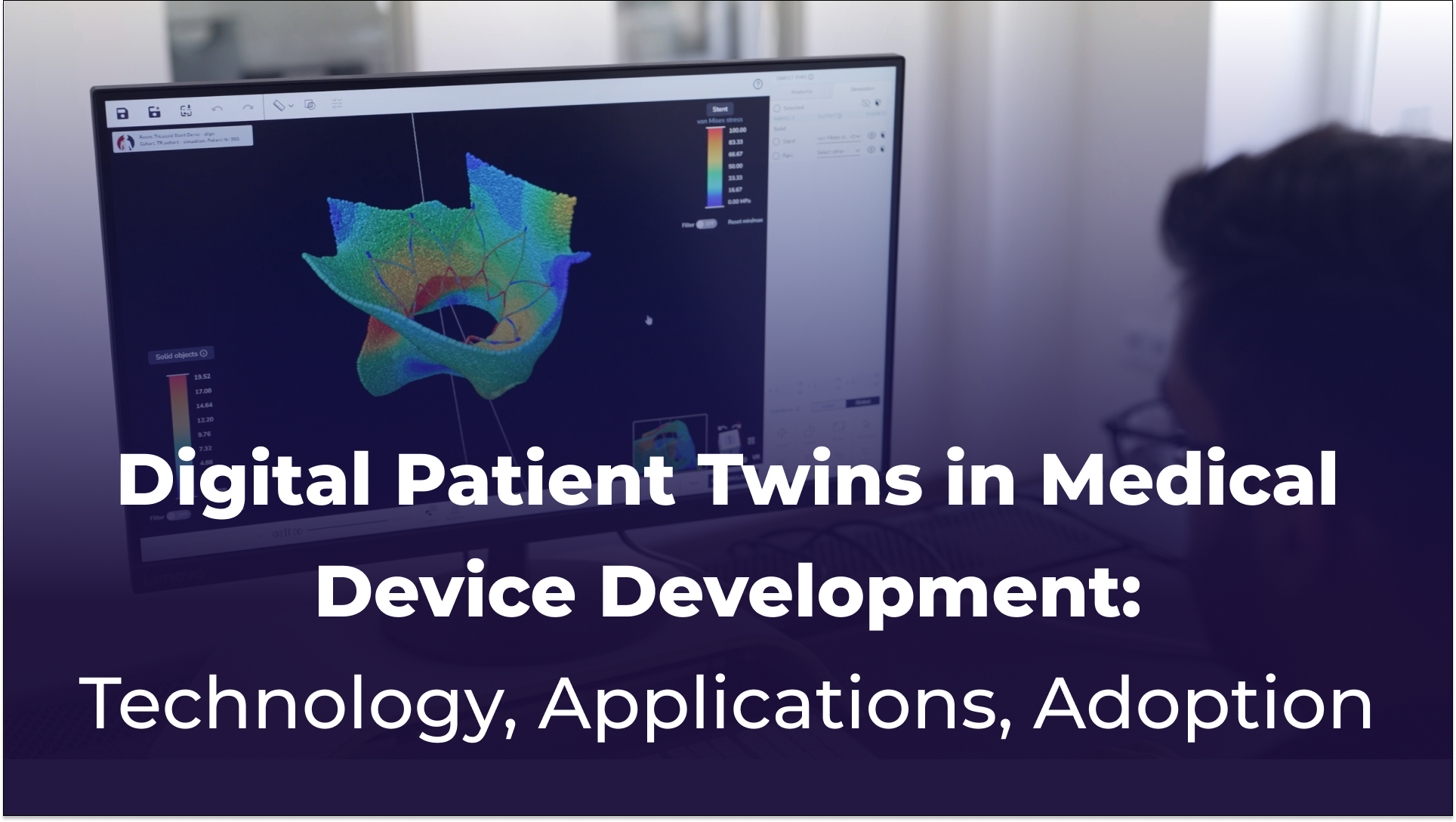
Digital Patient Twins in Medical Device Development: Technology, Applications, Adoption
Author:
Last updated: August 2026

DR. SIMON J. SONNTAG
CEO & Co-Founder
Simon is Co-Founder and CEO of Virtonomy, where he leads the company’s strategy, business development, fundraising, and the commercialization of its AI-powered digital twin technologies for medical device development. He brings more than 15 years of experience across medical engineering, computational modeling, digital health, and medical device innovation.
A heart valve that fits a 70-year-old patient may fail in a 12-year-old girl with a congenital malformation. Clinical trials and animal models capture the anatomical diversity of real patients only to a limited extent.
Digital patient twins close this gap. They make real patient anatomies virtually available and enable testing on hundreds of anatomically distinct patients—long before the clinical trial. The models are reconstructed from clinical imaging data and used to evaluate medical devices on virtual cohorts.
This guide explains what digital patient twins are, how they are created, and how cardiovascular MedTech companies use them in device development.
Key Takeaways
- A digital patient twin is a 3D computer model of a real patient’s anatomy, reconstructed from CT or MRI imaging data and validated for use in medical device simulation.
- Virtonomy’s v-Patients platform provides an extensive cohort of digital patient twins from the cardiovascular field. It includes, among others, pediatric, female, Asian, and rare pathological populations that are difficult to recruit physically.
- Digital patient twins enable virtual fitting, the identification of worst-case scenarios, sizing studies, and population coverage analyses. They can provide evidence that is usable for FDA and EU submissions within the framework of ASME V&V 40.
Why Digital Patient Twins Are Becoming Important
Medical devices are increasingly expected to perform across patient populations that differ considerably in anatomy, pathology, age, and sex. Traditional development methods capture this diversity only to a limited extent, because physical testing is constrained by recruitment, ethics, time, and cost.
Digital patient twins expand this evidence base. They make it possible to evaluate devices on anatomies that would otherwise remain inaccessible to physical studies—from pediatric cases through rare pathologies to anatomical edge cases.
Applications in Medical Device Development
Digital patient twins support five central use cases in device development: virtual fitting, worst-case identification, sizing studies, hemodynamic prediction, and post-market investigations.
Virtual Fitting Across Populations
A device can be tested on hundreds of patient anatomies within a few days, instead of recruiting hundreds of patients over years. Virtual fitting identifies the anatomical variants in which the device performs well and those in which it fails. Beyond the fit itself, implantation paths, vessel centerlines, curvatures, bending radii, torsion, tortuosity, and calcifications can also be analyzed. The results support the selection of suitable device sizes, the optimization of implantation strategies, and the definition of inclusion criteria for downstream studies.
Identifying Worst-Case Scenarios
The FDA and European Notified Bodies expect evidence of device behavior in the worst case. Digital cohorts make anatomical edge cases visible—such as heavily calcified valves as well as critical vessel geometries, extreme bending radii, or complex access routes that are often only rarely represented in physical studies. In silico testing against these cases provides robust evidence without putting patients at risk.
Sizing Studies for Underrepresented Populations
Pediatric cardiovascular devices are especially difficult to develop, because patient recruitment can be implemented only to a limited extent, both ethically and statistically. Digital pediatric cohorts enable sizing studies that would take years to conduct physically. The same applies to female morphology and Asian anatomies, where fit characteristics can differ from those of the standard study populations.
Hemodynamic Performance Prediction
Combined with computational fluid dynamics (CFD), digital patient twins make it possible to predict blood flow patterns through heart valves, around stents, and across LVAD outflow tracts. Simulations include blood flow, regurgitation, and the risks of hemolysis or thrombus formation, among others. For heart valve devices, these analyses can be aligned with requirements like DIN EN ISO 5840, depending on the device. Hemodynamic prediction supports both design optimization and regulatory-relevant performance characterization.
Investigating Post-Market Edge Cases
If unexpected device behavior occurs in the field, virtual patient twins make it possible to reconstruct the underlying anatomical scenario and compare different design changes or implantation strategies before physical tests or redesigns are carried out.
Wondering how these applications translate into regulatory-grade evidence?
We’ll show you how virtual fitting, worst-case testing, and population coverage fit into your submission strategy.
What Is a Digital Patient Twin?
A digital patient twin is a three-dimensional computer model of a specific patient’s anatomy, reconstructed from real clinical imaging data such as CT or MRI. Each twin preserves the patient’s actual anatomical geometry, including disease-specific features such as calcifications, malformations, or anatomical variants. Digital patient twins thus form the foundation of in silico clinical trials in cardiovascular medical device development.
The terms digital twin, virtual patient, and digital patient twin are often used in similar ways. Strictly speaking, the digital twin is the broader term for the virtual representation of a physical system. The virtual patient places greater emphasis on the simulation use case. The digital patient twin refers to the patient-specific anatomical reconstruction of a real person and thus the concrete basis for medical device simulations.
A regulatory-ready digital patient twin contains validated geometry, material assignments—such as calcified versus healthy tissue—boundary conditions relevant to hemodynamic simulation, and documentation traceable back to the source imaging data.
How Are Digital Patient Twins Created?
Digital patient twins are created in four main steps: image acquisition, segmentation, validation, and platform integration. This process is not standardized across the industry but is developed individually by each provider. At Virtonomy, a dedicated Data & AI team handles data sourcing from clinic and hospital partners, develops the algorithms for segmenting the DICOM data—usually CT scans—in-house, and verifies each result for correct segmentation as part of quality assurance.
Image Acquisition
Patient imaging data comes from clinic and hospital partners under appropriate consent and data protection agreements. Scan quality, pixel resolution, and contrast protocol influence the accuracy of the resulting twin. Image acquisition is carried out specifically according to the relevant pathology—such as tricuspid regurgitation, abdominal aortic aneurysm, or atrial fibrillation—so that the cohort reflects the real-world target populations.
Segmentation and 3D Reconstruction
The relevant anatomical structures are segmented from the volumetric imaging data. The result is a high-resolution 3D mesh that represents the patient-specific geometry, including pathological features. In addition, anatomical landmarks and relevant measurements are extracted to enable patient-specific analyses and statistical cohort comparisons.
Validation and Quality Assurance
Each twin’s geometry is validated against the source imaging data. The validation documentation is retained as part of the credibility evidence in accordance with ASME V&V 40. Digital twins that do not pass validation are excluded from the production cohorts.
Integration into the Platform
Validated digital twins are organized by anatomy, pathology, and demographic characteristics. The cohort can be queried in a targeted way via the v-Patients platform, so that device developers can select suitable models for their Context of Use. Beyond this, statistical population analyses can be carried out, target populations defined, and inclusion and exclusion criteria for virtual trials derived.
In addition to data from clinic partnerships, customers can bring their own imaging data. Anyone who already has CT scans of a patient on hand can upload them via the platform. Virtonomy anonymizes and segments the data and converts it into a digital patient twin. This is especially relevant for pre-operative planning: before a device implantation, the individual twin can be used to check which device fits best and how the procedure can be prepared, before the patient enters the operating room.

The v-Patients Cohort
The meaningfulness of in silico studies depends substantially on how well the underlying patient cohort represents the eventual target population. This is why the composition of the cohort plays a central role.
The v-Patients platform today includes more than 2,500 validated digital patient twins. The platform covers structural heart disease, vascular disease, and other cardiovascular anatomies. Available cohorts include, among others, right-heart anatomies for tricuspid interventions such as TTVR, abdominal aortic anatomies for vascular device development, and other disease-specific populations—for example, related to the mitral valve, LAA occlusion, or LVAD. Through clinical partnerships, these cohorts continue to grow steadily.
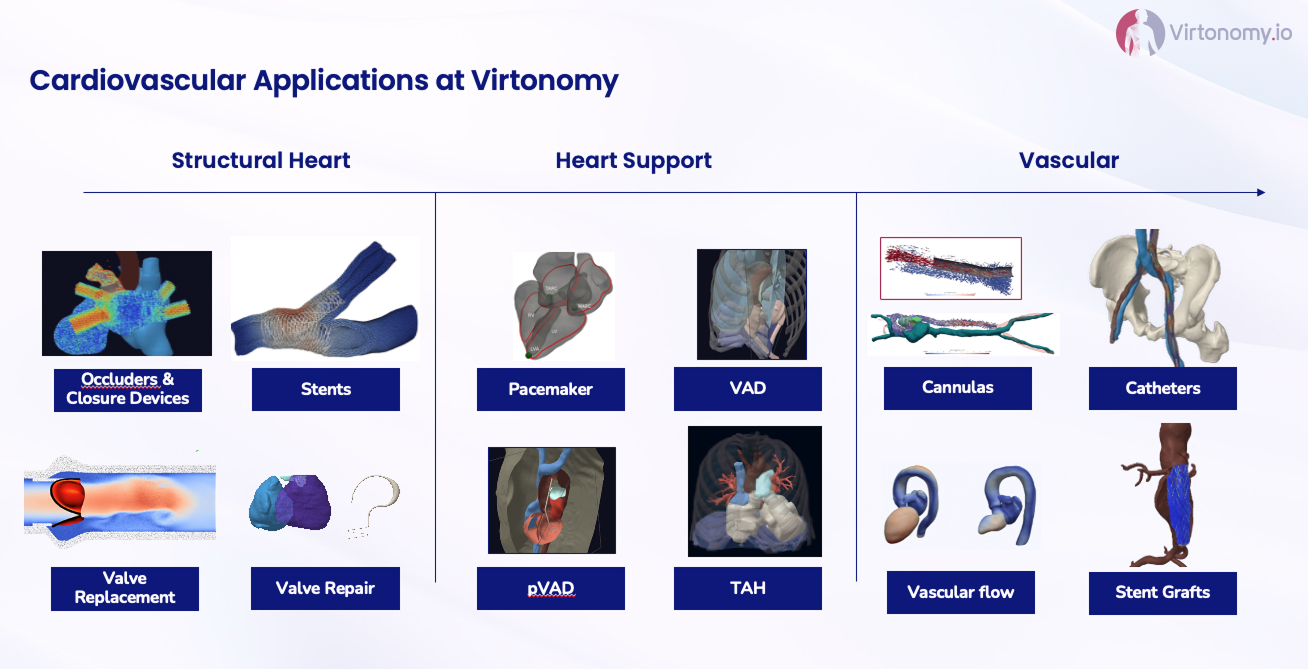
Clinical trials structurally struggle to recruit pediatric, female, and rare pathological cohorts on the scale needed for statistical significance. The v-Patients cohort closes this gap. Pediatric anatomies, female cardiovascular morphology, and Asian patient anatomies are explicitly represented, thereby supporting device development for populations that are systematically underrepresented in physical clinical evidence.
Why Cohort Diversity Matters
Cardiovascular devices that perform well in the cohorts of clinical trials can fail in real-world populations that the trial never recruited. Cohort diversity in digital patient twins is the structural response to this gap. Statistical analysis of virtual cohorts also allows conclusions about population coverage and supports the selection of representative study populations as early as the early development phases.
Regulatory Expectations
The FDA and European Notified Bodies expect device evidence to reflect the populations the device will later serve. Demonstrating that a device has been evaluated across diverse digital cohorts strengthens the population coverage within the submission. In the context of the clinical evaluation under the EU Medical Device Regulation (MDR) 2017/745 as well, demonstrating population coverage is gaining importance.
Pediatric, Female, and Underrepresented Populations
Pediatric, female, and geographically diverse populations are difficult to recruit at the scale and with the statistical significance that cardiovascular device studies require. Digital cohorts allow device evaluation on populations that physical studies cannot assemble at the necessary scale. They do not replace clinical evidence but complement it precisely where physical studies reach their limits.
Confidence in Real-World Performance
Devices evaluated on diverse digital cohorts reveal failure modes earlier in development—before costly physical studies and before incidents in the market. Beyond regulatory compliance, this is the strongest commercial argument for cohort diversity.
Validation and Regulatory Acceptance
The FDA accepts in silico evidence when the underlying computational model has demonstrated sufficient credibility for its Context of Use within the framework of ASME V&V 40. European Notified Bodies consider appropriately documented models as part of the clinical evaluation.
ASME V&V 40 Framework
The ASME V&V 40 standard specifies how the credibility of a computational model is assessed relative to its intended use. Digital patient twins are evaluated according to this framework: validation of the geometry, validation of the material assignments, and validation of the simulation results against real-world data, where available. The standard does not prescribe specific cohort sizes but specifies how the adequacy of a cohort is to be demonstrated.
FDA Acceptance
The FDA accepts in silico evidence when the underlying model has demonstrated sufficient credibility for its Context of Use in the sense of ASME V&V 40, as described in the FDA guidance “Assessing the Credibility of Computational Modeling and Simulation in Medical Device Submissions.” Applicants are encouraged to align on the Context of Use with the reviewers before the formal submission. Results from validated digital patient cohorts have already been part of device submissions accepted by the FDA and European Notified Bodies.
Documentation and Traceability
Each digital twin in a production cohort carries its own documentation: metadata on the source images, segmentation method, validation references, and version history. This traceability is what distinguishes regulatory-robust digital cohorts from purely research-based models.
Want to dive deeper into the topic?
Learn how in silico clinical trials work, what role ASME V&V 40 plays, and how the FDA and EU assess virtual evidence.
How to Integrate Digital Patient Twins into Your Workflow
Integrating digital patient twins into the development workflow requires three decisions: mapping the Context of Use to cohort requirements, the build-vs-buy decision, and planning the workflow integration.
Map the Context of Use to Cohort Requirements
First, you define which regulatory or design decision the simulation is meant to support, and from that you derive the necessary cohort characteristics. A worst-case heart valve study requires extreme anatomies; a sizing study for a pediatric device requires age-stratified pediatric cohorts.
Decide Build vs. Buy
Building your own digital twin cohort requires imaging partnerships, segmentation infrastructure, validation pipelines, and ongoing maintenance. For many cardiovascular MedTech teams, using an existing validated platform can shorten the time to starting simulation studies. The build-vs-buy decision depends on project volume, in-house expertise, and time pressure.
Plan the Workflow Integration
Working with digital patient twins fits into existing device development workflows: CAD import, virtual implantation, simulation runs, and regulatory results documentation. The platform should deliver results that fit into existing regulatory submission templates without additional downstream effort.
Virtonomy’s Approach
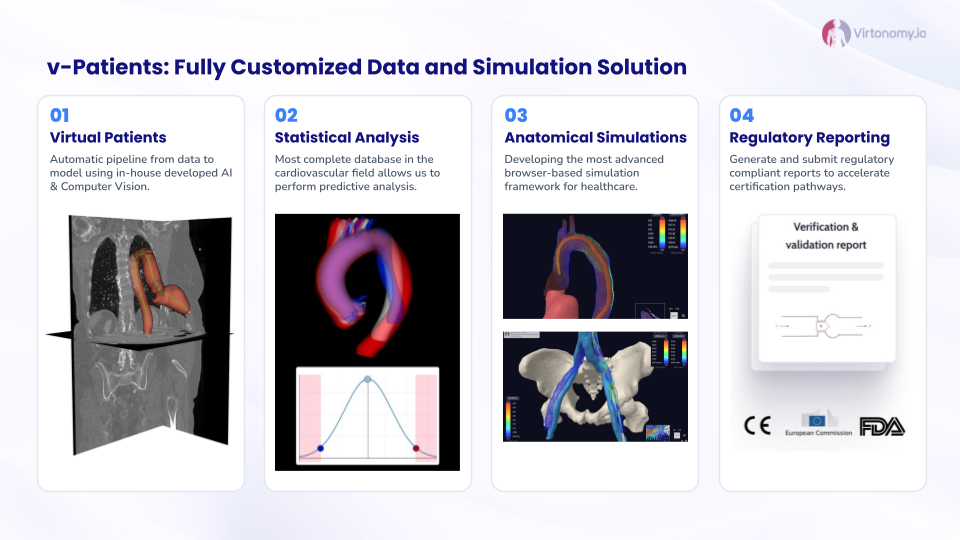
v-Patients is a platform built specifically for cardiovascular medical device development, combining a validated patient cohort with browser-based simulation and analysis tools. The platform was purpose-built for device development, not derived from generic simulation software, and covers the cardiovascular in silico process end to end.
The platform brings together three features that are especially relevant for cardiovascular device teams.
First, v-Patients can be used across the entire development cycle—from early design phases through late-stage prototypes to preparation for regulatory approval. Many solutions on the market focus either on patient data or on individual simulation steps. v-Patients combines a validated patient cohort with browser-based simulation within a single platform.
Second, Dr. Tina Morrison serves on the advisory board—a former FDA Medical Officer and architect of the ASME V&V 40 standard. As CEO of Virtonomy I am actively involved in the Avicenna Alliance, the European stakeholder body for in silico methods in regulatory science.
Third, leading cardiovascular MedTech companies use the platform, including Medtronic, Boston Scientific, Abiomed, Biotronik, and Getinge. Results based on validated digital patient cohorts have already been considered by the FDA and European Notified Bodies in the context of device submissions.
Practical Examples from MedTech Development
Digital patient twins offer not only theoretical benefits but already support regulatory development programs. For a compassionate-use application to the BfArM, Virtonomy provided simulation-based fatigue evidence within a three-week submission window—instead of the roughly six months estimated for conventional evidence. The results contributed to the successful first-in-human implantation of the device in Germany.
The benefit in clinical trials is documented as well: in a use case documented by the Drug Information Association, the use of virtual patient cohorts reduced the number of required trial participants by 256. At the same time, the device was launched two years earlier; the cost reduction in clinical development was reported at 10 million US dollars.
Both examples show the practical value of digital patient twins: they do not replace clinical trials, but they enable more informed design decisions, improve coverage of anatomical diversity, and deliver regulatory-grade evidence as early as the early development phases.
Get to know Virtonomy’s v-Patients. Learn how digital patient twins are used in real-world development projects.
Frequently Asked Questions
What is a digital patient twin?
A digital patient twin is a three-dimensional computer model of a real patient’s anatomy, reconstructed from CT or MRI imaging data. Each twin preserves the actual anatomical geometry, including disease-specific features. It serves as a validated basis for medical device simulations within in silico clinical trials.
How does a digital patient twin differ from a digital twin or virtual patient?
Digital twin is the broader term for any virtual representation of a physical system. Virtual patient places greater emphasis on the simulation case. The digital patient twin is the concrete, patient-specific anatomical reconstruction of a real person and thus the basis for medical device simulations.
How are digital patient twins validated?
Each twin’s geometry is checked against the source imaging data. Material assignments—such as calcified versus healthy tissue—are verified. The validation documentation follows the requirements of ASME V&V 40. Twins that do not pass this check are excluded from production cohorts.
Can digital patient twins replace clinical trials?
No, digital patient twins do not replace clinical trials—they complement them. They provide evidence for phases and populations that physical studies struggle to cover, such as worst-case anatomies or pediatric cohorts. In regulatory terms, they remain one building block alongside clinical and pre-clinical evidence.
Can companies create digital patient twins from their own patient data?
Yes, customers can upload their own CT or MRI data via the platform. Virtonomy anonymizes and segments this data and converts it into a digital patient twin. This is especially relevant for pre-operative planning—for example, to check the fit of a device on the individual patient in advance.
Does the FDA accept evidence based on digital patient twins?
Yes, the FDA accepts in silico evidence when the underlying computational model has demonstrated sufficient credibility for its Context of Use in the sense of ASME V&V 40.
Conclusion
Digital patient twins solve a structural problem in cardiovascular medical device development: the gap between study cohorts and real-world populations. They help MedTech companies validate development decisions earlier, better represent anatomical diversity, and build regulatory-robust evidence more efficiently.
The technology does not replace clinical trials. It complements them where physical studies reach their limits: with rare pathologies, pediatric cohorts, worst-case anatomies, and underrepresented populations. This makes digital patient twins an important building block of modern medical device development.

Ready to incorporate Virtonomy’s digital patient twins into your development strategy?
Talk with Virtonomy’s experts about your use case and learn how virtual trials can be meaningfully combined with existing in vitro and in vivo workflows.