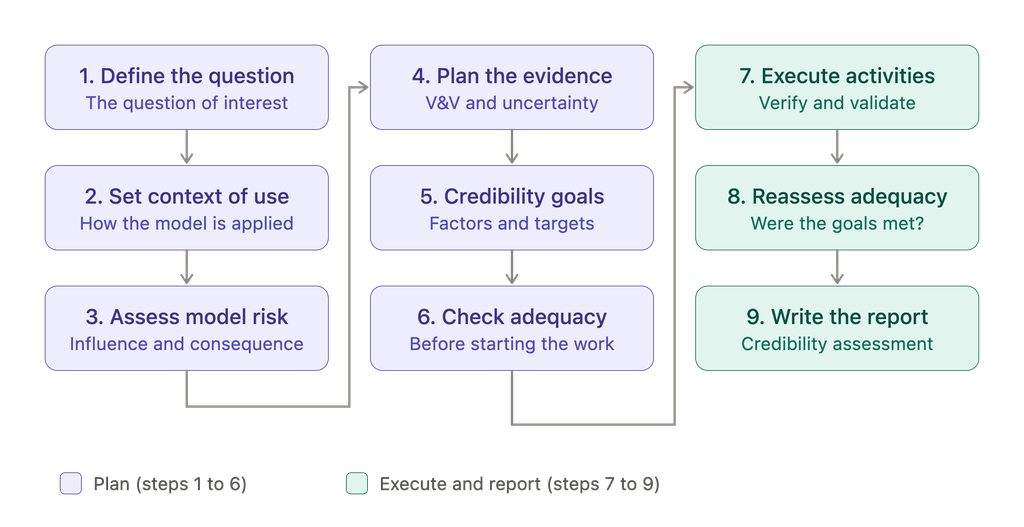
In brief: ASME V&V40 is the standard for establishing that a computational model is credible enough to support a medical device decision. Compliance involves defining the question of interest and context of use, assessing model risk, setting credibility goals proportionate to that risk, generating the corresponding evidence, and documenting the outcome in a credibility assessment report. The FDA’s guidance on model credibility structures this process into nine steps.
As computational modeling takes on a larger role in regulatory submissions, one question determines whether the evidence will be accepted: is the model credible for its intended use?
Bench testing, animal studies and clinical trials have long formed the foundation of premarket evidence. Computational modeling is now widely regarded as a further pillar, and the ASME V&V40 standard has been central to that development. This guide outlines how manufacturers can apply it in practice.
What is ASME V&V40?
ASME V&V40, published in 2018, is the first standard dedicated to assessing the credibility of computational models used for medical devices. It is a risk-informed framework rather than a prescriptive checklist. It does not dictate which tests to perform. Instead, it establishes how much evidence a model requires, based on the role the model plays in a decision and the consequences of that decision being wrong.
The guiding principle is proportionality: the greater the reliance on a model and the more serious the potential patient impact, the stronger the evidence of credibility must be.
Is V&V40 required by the FDA?
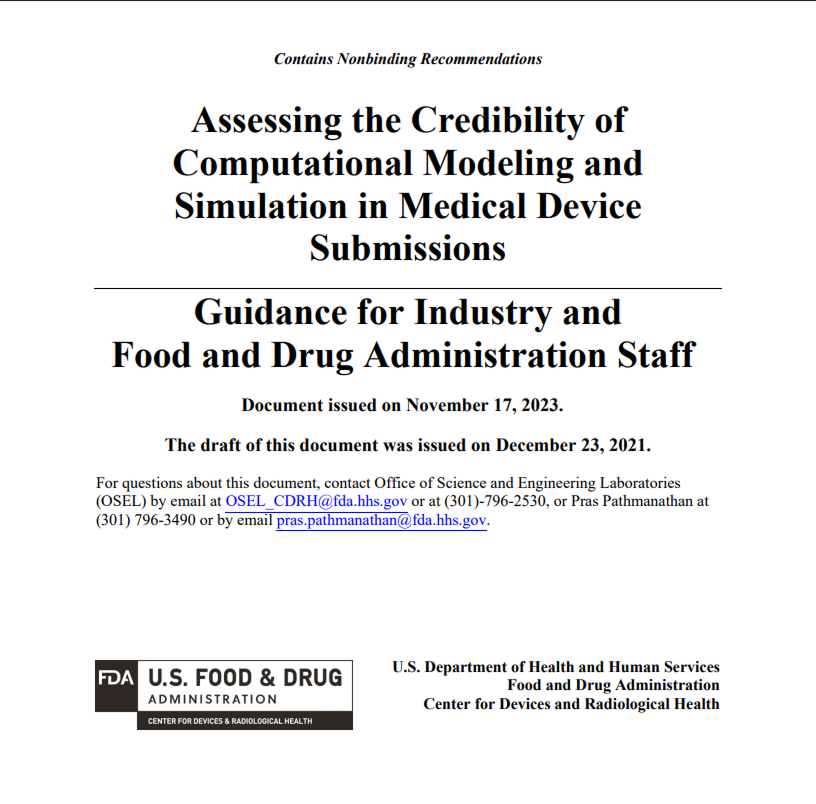
V&V40 is a recognized consensus standard rather than a legal requirement. However, the FDA’s guidance on assessing the credibility of computational modeling and simulation in medical device submissions is consistent with V&V40 and builds on the same risk-informed approach. For manufacturers, following V&V40 is a well-established route to producing evidence in a form regulators are prepared to review.
How do you comply with ASME V&V40? The nine steps
The following sequence reflects the structure of the FDA’s credibility framework.
Step 1: State the question of interest
Define the specific decision the model is intended to inform. An example would be whether an implant remains stable across the anatomical range of the target population.
A precisely stated question focuses the entire credibility effort. An imprecise one leads to evidence that is difficult to evaluate.
Step 2: Define the context of use
The context of use (COU) specifies how the model will be applied to answer the question of interest and what role it plays alongside other evidence, such as bench or clinical data. A well-formed COU addresses:
- The phenomena simulated and the outputs relied upon
- The patient population or anatomical range covered
- Whether the model supports, supplements or replaces other evidence
Credibility is always assessed against the COU, which makes it the most consequential document in the process.
Step 3: Assess model risk
Model risk is determined by two factors:
- Model influence: the weight of the model in the decision relative to other available evidence
- Decision consequence: the severity of potential harm to patients if the decision is incorrect
A model that serves as the sole evidence for a high-risk device presents high model risk. A model that supplements extensive physical testing for a lower-risk decision presents considerably less. This assessment establishes the level of rigor required in the steps that follow.
Step 4: Identify the credibility evidence to be collected
Determine the evidence that will establish confidence in the model. This typically comprises verification, validation and uncertainty quantification, and may include supporting evidence from comparable devices or prior studies.
Step 5: Define credibility factors and goals
This step is the core of the framework and consists of three parts:
- Identify the relevant credibility factors. V&V40 describes 13, organized under verification, validation and applicability. Examples include numerical code verification, model inputs, test conditions, output comparison, and the relevance of validation activities to the COU.
- Define a gradation of activities for each factor, from limited to highly rigorous.
- Select a credibility goal for each factor, informed by the model risk established in Step 3.
Higher model risk calls for more rigorous activities and stricter acceptance criteria. The rationale behind each goal should be documented, as reviewers will expect to see it.
Step 6: Conduct a prospective adequacy assessment
Before committing resources, evaluate whether achieving the stated goals would provide sufficient evidence for the COU at the identified level of risk. This prospective assessment is considerably less costly than discovering a gap after the validation work is complete.
It is also an appropriate point to engage the FDA through the pre-submission process. Aligning early on the COU, risk assessment and credibility plan reduces uncertainty later in the review.
Step 7: Execute the credibility activities
Carry out the planned verification and validation. Verification confirms that the model is implemented and solved correctly and that numerical errors are quantified. Validation compares model predictions with reliable reference data, such as benchtop measurements or in-human imaging, against acceptance criteria defined in advance.
Two considerations improve the strength of the evidence:
- Quantify uncertainty. Sensitivity analysis and the propagation of input uncertainty demonstrate a clear understanding of the model’s limitations.
- Validate in conditions close to the COU. Evidence that closely reflects the intended use carries substantially more weight than a generic comparison.
Step 8: Conduct a post-study adequacy assessment
Once the activities are complete, assess whether each credibility factor has reached its goal and whether the overall evidence is sufficient for the COU. If it is not, there are three accepted options: generate additional evidence, refine the model, or reduce the model’s influence on the decision by adding other forms of evidence. Whichever is chosen, the rationale should be recorded.
Step 9: Prepare the credibility assessment report
A clearly structured report allows a reviewer to follow the logic from the question of interest and COU, through model risk and credibility goals, to the evidence and conclusions. It should include:
- A description of the device
- The credibility assessment (Steps 1 to 6)
- The credibility evidence
- The limitations of the assessment
What are common mistakes in V&V40 implementation?
- Defining the COU too broadly. A broad COU demands broad validation, which is difficult to support.
- Treating V&V40 as retrospective documentation. The framework is most effective as a planning tool from the outset of a project.
- Omitting uncertainty quantification. Predictions without error bounds are difficult for reviewers to rely on.
- Validating against data that does not reflect the intended use. Relevance is as important as agreement.
- Omitting the prospective adequacy assessment. Identifying a gap during planning is far less costly than identifying it after the study.
How does Virtonomy support V&V40 compliance?
Effective V&V40 implementation requires both computational expertise and regulatory experience. Virtonomy has worked exclusively in cardiovascular device development for more than six years. Our methods are validated against ASME V&V40, fully ISO compliant, and accepted by FDA and EU regulatory bodies as digital evidence.
The v-Patients platform combines thousands of virtual patients, statistical shape models representing worst-case and average anatomies, and validated ISO benchtop and in-human implant simulations. Our regulatory team supports each step of the process, from defining the COU to compiling a validated virtual evidence report. Customers also benefit from the guidance of Dr. Tina Morrison, who led the development of V&V40 during her time at the FDA and now advises Virtonomy.
For further context, see What Does the FDA Think About In Silico Evidence? and In Silico vs. In Vitro vs. In Vivo: When to Use Each Method.

Frequently asked questions
What does V&V40 stand for?
V&V stands for verification and validation. “40” is the designation of the ASME standard on credibility assessment of computational models for medical devices. Verification confirms that a model is implemented and solved correctly, and validation confirms that it adequately represents reality.
What is a context of use in V&V40?
The context of use is a statement defining how a model will be used to answer a specific question of interest, including its role relative to other evidence. Credibility is always assessed against it.
What is model risk?
Model risk combines model influence, which is the weight of the model in a decision, and decision consequence, which is the severity of patient harm if that decision is wrong. It determines the rigor of evidence required.
How many credibility factors does V&V40 define?
V&V40 defines 13 credibility factors, spanning verification, validation and applicability.
Does the FDA accept computational modeling as regulatory evidence?
Yes. The FDA has issued guidance on assessing the credibility of computational modeling and simulation in submissions, and it encourages early engagement on modeling strategy through pre-submission channels.
Does V&V40 apply to all medical devices?
V&V40 is a general framework designed to be applicable across device types, including implants, stents, catheters and heart valves. The level of evidence required depends on the model risk in each specific context of use.
Build your virtual testing plan with our experts
Virtonomy offers a free regulatory consultation workshop in which our experts work with your team to establish a virtual testing plan aligned with your physical testing strategy. The workshop is tailored to your device, therapeutic area and the applicable FDA and EU guidance and ASME standards.

Talk to Us About Your Development Project
v-Patients supports the development of cardiovascular medical devices for valve replacement, structural heart interventions, and vascular applications—from the early design phase to regulatory preparation. New use cases are added as MedTech partners investigate further device categories on the platform. With pre-operative planning, the same digital twin technology can also be applied beyond research and development to clinical use.