

In Silico Clinical Trials: The Complete Guide to Medical Device Development
Author:
Last updated: August 2026

DR. SIMON J. SONNTAG
CEO & Co-Founder
Simon is Co-Founder and CEO of Virtonomy, where he leads the company’s strategy, business development, fundraising, and the commercialization of its AI-powered digital twin technologies for medical device development. He brings more than 15 years of experience across medical engineering, computational modeling, digital health, and medical device innovation.
A cardiovascular medical device team is planning its next design iteration. Every physical prototype costs time. The traditional path — prototype, bench test, animal study, and clinical trial — is no longer the only option today. In silico clinical trials simulate a medical device’s performance on digital patient twins before it is ever used in humans. The result: regulatory-grade evidence, faster development, and access to hard-to-recruit patient groups.
This guide explains what in silico clinical trials are, how they work, and how they contribute to the development of cardiovascular medical devices.
Key Takeaways
- An in silico clinical trial is a computational simulation of a medical device’s performance across a virtual patient cohort.
- The FDA and European Notified Bodies consider in silico evidence when the underlying model meets the requirements of the ASME V&V 40 standard.
- In silico methods shorten iteration cycles, lower prototyping costs, broaden access to diverse patient populations, and can reduce reliance on animal testing.
What Is an In Silico Clinical Trial?
An in silico clinical trial is a computational simulation that tests a medical device’s performance across a virtual patient cohort. It runs entirely in software and generates evidence that regulatory authorities such as the FDA and European Notified Bodies consider during device approvals. In silico is the umbrella term for any computational method in product development — literally “in the computer.”
The difference from other types of testing is best seen in a direct comparison:
| Criterion | In Vitro | In Vivo | In Silico |
|---|---|---|---|
| What is tested | Mechanical and material-related performance | Biological response, clinical safety | Device behavior across virtual patient cohorts |
| Environment | Lab bench, mock setups | Living animal or human | Computer simulation |
| Time per iteration | Days to weeks | Months to years | Hours to days |
| Cost per iteration | Low to medium | High to very high | Low to medium |
| Population diversity | None (single test setup) | Limited by recruitment | High (curated cohorts) |
| Regulatory acceptance | Established, required | Established, required for most devices | Established under ASME V&V 40 |
| Ethical considerations | Minimal | High (animals, humans) | Minimal |
| Typical phase | Throughout development | Pre-clinical and clinical | Early design to approval |

An in silico clinical trial is a regulatory-oriented form of computational modeling and simulation. In practice, terms such as digital evidence, Computational Modeling and Simulation (CM&S), or virtual testing are also used for it. The in silico clinical trial refers to the part of these methods aimed at generating regulatory-grade evidence.
For a simulation to count as evidence in a regulatory submission, four elements are required: a validated model, a clearly defined Context of Use (CoU) — that is, the specific intended purpose of the model — a credibility assessment following the ASME V&V 40 framework, and documented results that relate to the CoU. If any one of these elements is missing, the simulation remains an engineering tool. With all four, it becomes evidence that regulatory authorities can accept.
How In Silico Clinical Trials Work
The process follows four steps, from the virtual patient cohort to the completed regulatory submission dossier. Whether a single design iteration, an entire patient cohort, or a regulatory question is being investigated, every in silico clinical trial follows the same basic principle.
Step 1: Build the virtual patient cohort
Digital patient twins are three-dimensional anatomical models created from CT or MRI imaging. A cohort is assembled to reflect the variation of the real-world population: age, sex, and disease severity are all factored in. A cardiovascular cohort for a device such as a heart valve or a stent typically includes hundreds of patients. The quality and diversity of this cohort determine how meaningful the trial’s results are. Specialized platforms already provide curated digital patient cohorts that capture a range of anatomical and demographic characteristics.
Step 2: Integrate the device model
The medical device is introduced into each digital patient twin’s anatomy as a geometric model — for example, as a CAD or STL file. The simulation parameters are then defined, including material properties, boundary conditions, and operating parameters. Depending on the device, different implantation paths, device sizes, material properties, and boundary conditions can be investigated. Virtual implantations, for instance, make it possible to assess bending radii, device stresses, positioning, or the steerability of a catheter across numerous patients.
Step 3: Run the simulation
The simulation now computes how the medical device interacts with the anatomy under realistic conditions. Depending on the device class, insertion paths, vessel curvature, bending radii, torsion, tortuosity, or calcifications can additionally be analyzed. These patient-specific parameters help identify design weaknesses early and compare different device variants with one another.
Step 4: Generate evidence
The simulation results are documented in a verification and validation (V&V) report and prepared for regulatory submissions in line with the recommendations of the FDA and the European Commission. The basis for this is a clearly defined CoU and the Question of Interest (QoI) that the model is intended to answer. A coverage analysis of the virtual patient cohort shows how the device performs across the entire population, while identified edge cases point to areas where supplementary physical testing may be worthwhile. The results can then feed directly into the technical documentation and the regulatory submission dossier.
Looking for a practical example? Explore how digital patient twins support cardiovascular device development—from valve simulations to catheter design optimization and virtual bench testing.
Regulatory Consideration: FDA, EU, and ASME V&V 40
The FDA accepts computational modeling and simulation evidence under appropriate validation conditions, particularly when the model meets the requirements of the ASME V&V 40 standard. The European Medical Device Regulation (MDR) allows the use of such evidence in the clinical evaluation; the specific assessment in each individual case rests with the responsible Notified Body.
FDA Acceptance
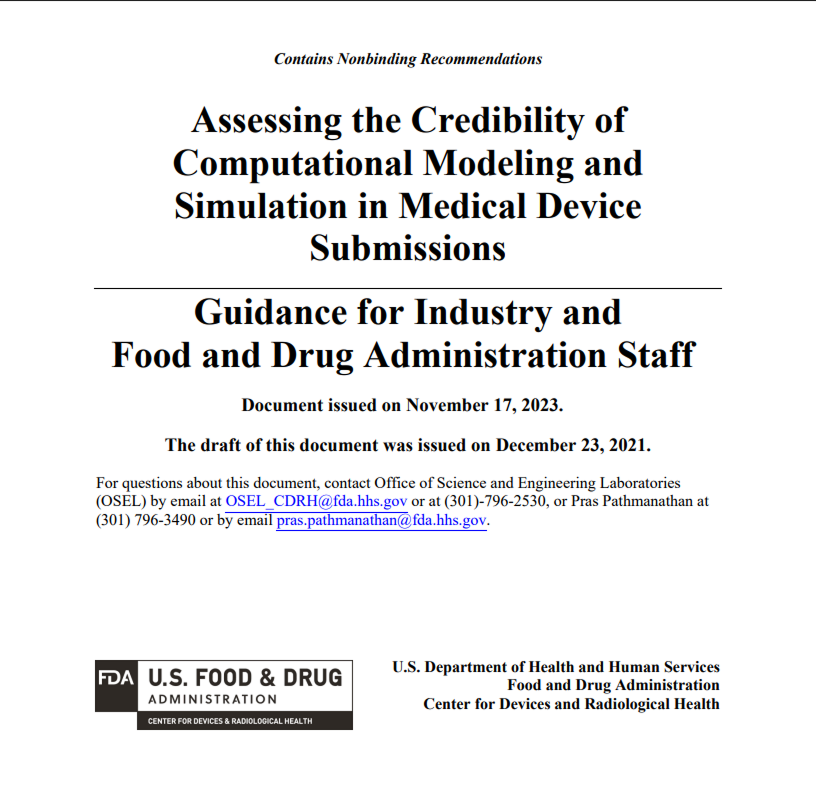
The FDA’s Center for Devices and Radiological Health (CDRH) published an initial guidance in 2016 on reporting requirements for computational modeling in submissions. On November 16, 2023, the final guidance “Assessing the Credibility of Computational Modeling and Simulation in Medical Device Submissions” followed, which is closely aligned with ASME V&V 40 and prescribes a nine-step process for credibility assessment. Pre-submission meetings (Q-Sub) give manufacturers the opportunity to align with the agency on the CoU and Question of Interest before the full simulation program runs. This reduces the risk of later rework. Precedents already exist for cardiovascular implants, infusion pumps, and orthopedic devices.
The ASME V&V 40 Standard
The full name is “Assessing the Credibility of Computational Modeling Through Verification and Validation: Application to Medical Devices.” Published on November 15, 2018 by the American Society of Mechanical Engineers, it was conceived by Dr. Tina Morrison during her time at the FDA. Using 13 credibility factors, the standard defines how a model’s credibility is assessed relative to its CoU — not in the abstract. It does not prescribe any particular simulation method, only how to demonstrate that the chosen method is sufficient for the decision at hand.
The EU and International Landscape
In Europe, there is as yet no standalone, harmonized framework comparable to the FDA guidance for assessing the credibility of computational models. In silico results can be considered as part of the technical or clinical evidence within the relevant regulatory context. Their assessment, however, is made on a case-by-case basis by the responsible Notified Body.
Documentation aligned with ASME V&V 40 can help present the Context of Use, the model risk, and verification and validation activities in a transparent, traceable way. The Avicenna Alliance is actively advancing the regulatory and methodological development of in silico medicine in Europe.
For manufacturers, this means that in silico studies are increasingly used not merely as an internal engineering tool but as a component of regulatory development programs. Platforms such as Virtonomy’s v-Patients support this process with workflows and documentation geared to regulatory requirements in the US and Europe.
Are you planning to use in silico evidence? An early-defined Context of Use and a suitable simulation strategy can considerably ease the later approval process. We’d be glad to show you what matters most here.
When to Use In Silico Clinical Trials
In silico clinical trials can be applied across development phases, application types, and device classes. Most cardiovascular MedTech teams find at least one point where the method fits their current work.
By development phase:
- Early design: rapid geometry iteration without physical prototypes
- Pre-clinical: virtual fitting across patient populations for sizing
- Before approval: structured evidence generation, aligned with FDA and EU expectations
- Post-market: simulation of rare anatomies and edge cases drawn from field reports
By application type:
- Virtual implant fitting across hundreds of patient anatomies; beyond the fit itself, anatomical parameters such as vessel centerlines, curvatures, bending radii, or calcifications can be systematically evaluated to optimize implantation paths and device sizes on a data-driven basis.
- Population analyses to define target populations, derive inclusion and exclusion criteria, and systematically identify anatomical edge cases for downstream pre-clinical and clinical studies.
- Worst-case testing for the edge cases required by the FDA.
- Sizing studies across demographic subgroups, such as pediatric, female, or geographically distinct populations.
- Hemodynamic performance analyses for heart valve devices; here, blood flow, regurgitation, and the risks of hemolysis or thrombus formation can be simulated. Depending on the device, such flow analyses can be aligned with requirements like DIN EN ISO 5840.
- Fatigue analyses for stents and prosthetic heart valves; crimping, deployment, and cyclic loading along the implantation process can be simulated to identify critical material stresses well before extensive physical testing.
- Market-expansion testing, in which a device is evaluated against the patient anatomies of a new target region — such as an Asian population — before market entry.
By cardiovascular device class:
- Heart valves, including TAVI, TAVR, TTVR, and mitral valve devices
- Stents
- Left atrial appendage occluders (LAA occluders)
- Ventricular assist devices (VADs) and total artificial hearts
- Catheters and cannulas
Many of these use cases can be implemented with both in-house simulation environments and specialized platforms. What matters is less the tool than the quality of the virtual patient cohorts and the regulatory traceability of the results.
Advantages over Traditional Testing
In silico clinical trials offer four central advantages: speed, cost, population diversity, and reduced reliance on animal testing.
Speed: Iteration cycles shorten from months to weeks. Evaluating a design change no longer requires a new fixture or a new testing window — just a new simulation run. For most R&D leadership teams, this is the most reliable economic argument for in silico methods.
Cost: Instead of manufacturing and testing multiple physical prototypes, device variants can first be evaluated virtually using CAD models. Virtual studies can also help define inclusion and exclusion criteria before animal, cadaver, or clinical studies begin, enabling more targeted recruitment and testing. This reduces expenditure on prototype fabrication, materials, laboratory time, and study execution, although the savings vary by device class and development program.
Population diversity: Pediatric cardiovascular cohorts are hard to recruit physically, and female physiology is often underrepresented in traditional studies. Geographic variation and rare anatomies widen these gaps further. Virtual cohorts can represent these groups at a scale that physical studies rarely achieve.
Reduction of animal testing: In silico methods can replace some categories of animal testing — especially in early design screening — and reduce others by supporting better species selection. This aligns with the 3Rs principle (Replace, Reduce, Refine). It is a real advantage of the approach, one among several, not the primary reason enterprise teams adopt it.
Evidence quality: Outputs structured according to V&V 40 from the start reduce rework at submission. Pre-submission meetings become more substantive when a manufacturer arrives with structured CoU documentation rather than a preliminary concept.
Would you like to assess whether your device is suitable for an in silico study? In a no-obligation conversation, it is often quick to gauge which development or approval steps can be meaningfully supported by simulation.
How to Get Started with In Silico Clinical Trials
Getting started comes down to three decisions: define your own CoU, choose between in-house development and an external platform, and engage with regulatory authorities early.
Define Your Context of Use
The CoU is the specific regulatory decision the model is meant to inform, closely tied to the Question of Interest that the simulation is meant to answer. It determines every downstream decision: which physics is modeled, which validation activities are needed, and which credibility evidence must be collected.
An unclear or shifting CoU is the most common cause of rework in the late phases of in silico programs. It is worth clarifying before the actual simulation work begins.
Choose Between In-House Development and an External Platform
In-house development means building up CFD and FEA specialists, validated solver infrastructure, and a pipeline for patient imaging data. An external platform trades this upfront investment for a faster path to the first result and access to already-validated patient cohorts. The right choice depends on project volume, existing in-house expertise, and time pressure.
Specialized platforms such as v-Patients connect digital patient twins with simulation and documentation workflows. This can be especially worthwhile when results are needed quickly or when the required data, CFD, and FEA infrastructure is not fully available in-house.
Engage with Regulatory Authorities Early
Pre-submission meetings with the FDA for in silico evidence are becoming increasingly common, and good preparation makes them more effective. A draft CoU and an outline of the planned validation activities give the agency something concrete to respond to. Notified Bodies in the EU respond just as positively to early engagement.
The Virtonomy Approach: The v-Patients Platform
Virtonomy’s v-Patients is an in silico trial platform for the development of cardiovascular medical devices. It combines digital patient twins, browser-based simulation, and regulatory-oriented processes in a shared working environment. Through it, manufacturers gain access to a growing database of more than 2,500 digital patient twins without having to build up in-house CFD or FEA expertise. The database includes cohorts that are hard to assemble physically: pediatric patients, female anatomies, Asian patient populations, and diverse pathologies.
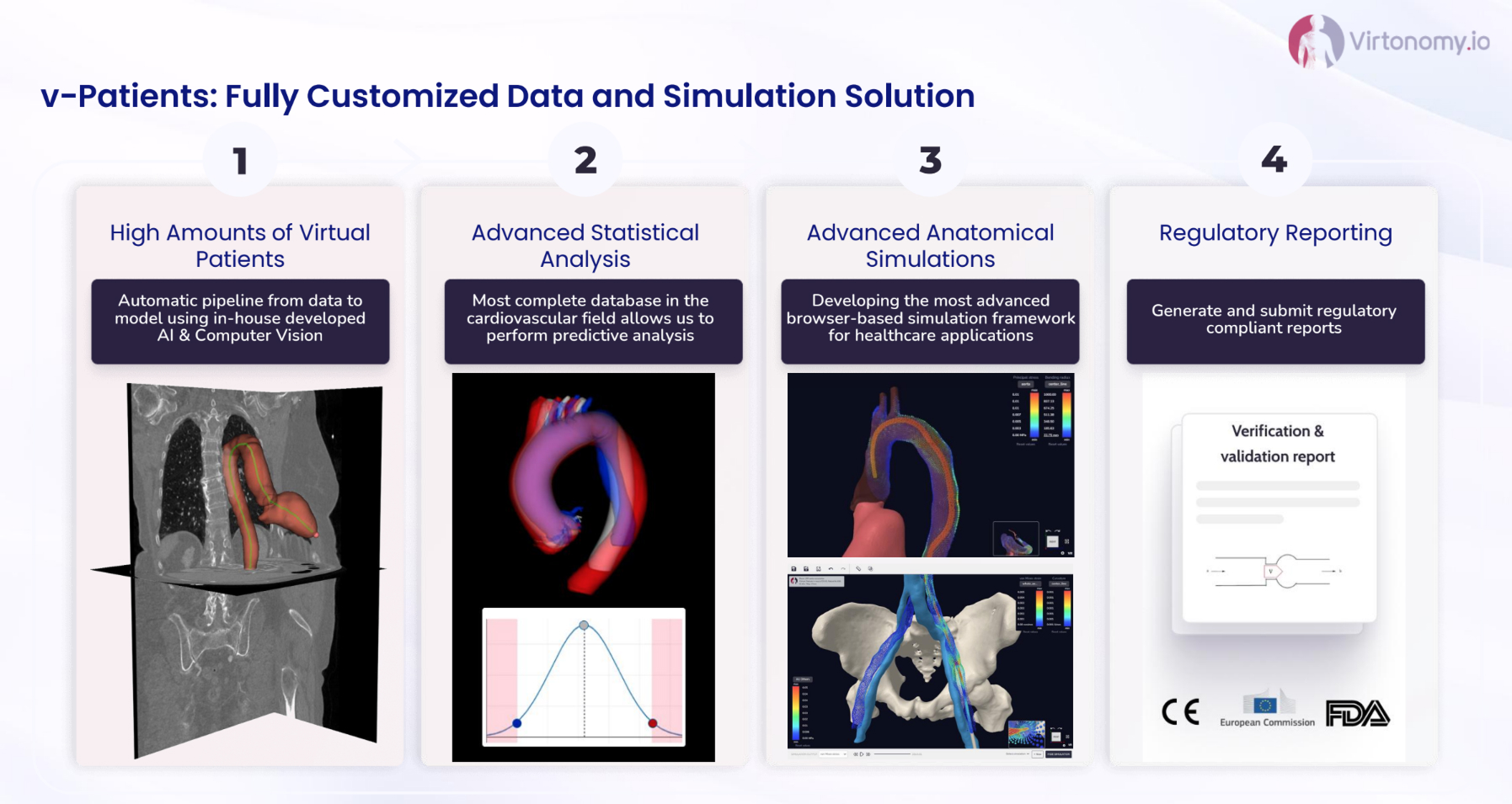
Three features characterize the platform. First, outputs are structured for FDA and EU submissions from the start, built around CoU and V&V 40 requirements. Second, the advisory board includes Dr. Tina Morrison, architect of the ASME V&V 40 standard, and Virtonomy CEO Simon Sonntag, an active member of the Avicenna Alliance. Third, v-Patients is already trusted by manufacturers such as Medtronic, Boston Scientific, Abiomed, Biotronik, and Getinge.
Practical Examples from MedTech Development
First-in-Human Implantation (Compassionate Use)
For a compassionate-use application to the German Federal Institute for Drugs and Medical Devices (BfArM), fatigue evidence was missing to demonstrate the durability of a cardiovascular medical device. The available submission window was only three weeks. Virtonomy delivered the required simulation-based fatigue evidence within that time frame — conventional evidence would typically have taken around six months.
Virtonomy carried out a simulation-based fatigue analysis based on in vivo measured loading conditions and documented the results in line with the FDA Reporting Guidance. The simulation data were included in the compassionate-use application to substantiate the durability evidence and supported the successful first-in-human implantation of the device in Germany.
Reduced Trial Size and Accelerated Market Launch
In a use case documented by the Drug Information Association, a healthcare company used simulation-based methods in the development of a pacemaker. This made it possible to reduce the number of required trial participants by 256. At the same time, development time was shortened by two years, while clinical development savings amounted to around 10 million US dollars.
Interested in what v-Patients can do for your company?
Frequently Asked Questions
Does the FDA accept in silico evidence in a device submission?
Yes, under appropriate validation conditions. The FDA has considered computational modeling and simulation evidence in submissions since the 2016 CDRH guidance on reporting requirements. In November 2023, a final guidance followed that is closely aligned with the ASME V&V 40 standard and prescribes a risk-based, nine-step assessment process. What matters is that the model is deemed credible for its specific CoU. Manufacturers typically align on this with the agency during a pre-submission meeting before starting the simulation program.
What is the difference between in silico, in vitro, and in vivo testing?
In vitro testing takes place on a physical bench in the lab, with real materials and real devices. In vivo testing involves animal or human studies. In silico testing runs entirely in software, using models and simulations on virtual patient cohorts instead of physical samples or subjects. An in silico clinical trial is the subset specifically designed to generate evidence that regulatory authorities can consider in approval decisions.
What is ASME V&V 40 and why does it matter?
ASME V&V 40 is a standard published on November 15, 2018 that, using 13 credibility factors, defines how the credibility of a computational model is assessed relative to its CoU. It does not prescribe any particular simulation method but provides a risk-based framework for demonstrating that a chosen method is sufficient for the regulatory decision at hand. The FDA recognizes the standard and bases its own 2023 guidance substantially on it.
How long does it take to set up an in silico study?
That depends on the CoU, the device class, and whether a manufacturer builds up capacity in-house or uses an existing platform with already-validated patient cohorts. In-house development requires months for solver infrastructure and data pipelines, whereas an external platform often delivers initial results within a few weeks. Defining the CoU early and engaging the agency through a pre-submission meeting generally shortens the overall timeline, because it avoids later rework.
Can in silico methods fully replace animal testing?
They can replace some categories — especially in early design screening — and reduce the scope of others by supporting more targeted species and model selection where animal studies are still needed. Full replacement is not yet the regulatory standard across all device classes, but the trend — supported by growing ethical and political pressure in Europe and the US — is clearly moving in this direction.
Which types of cardiovascular devices can be tested in silico?
Heart valves (TAVI, TAVR, TTVR, mitral valve devices), stents, left atrial appendage occluders, ventricular assist devices, total artificial hearts, and catheters and cannulas have already been evaluated with in silico methods. In several of these categories — such as cardiovascular implants and orthopedic devices — an established regulatory precedent already exists with the FDA and EU Notified Bodies.
How does Virtonomy support in silico clinical trials?
Virtonomy provides v-Patients, a platform for virtual trials in the development of cardiovascular medical devices. It combines digital patient twins, browser-based simulation, and regulatory-oriented documentation, allowing manufacturers to conduct virtual trials without building a complete simulation infrastructure themselves.
Conclusion: In Silico Clinical Trials Are Now Established
In silico clinical trials are increasingly becoming an integral part of medical device development. They complement bench, animal, and clinical studies wherever virtual patient cohorts enable faster development cycles, greater anatomical diversity, and regulatory-grade evidence. With established standards such as ASME V&V 40 and regulatory consideration by the FDA and the MDR, they lay the foundation for more efficient, data-driven product development.
Anyone who wants to explore whether and how in silico clinical trials can be meaningfully integrated into a specific development program can talk with the Virtonomy team about suitable use cases and regulatory requirements.

See our platform
v-Patients in action
Get a demo and see how our customers use v-Patients to speed up their device development and save costs.